What happens when a painting stops being something you look at and instead becomes a place you can step inside?
Most paintings ask us to stand in front of them. Trickorama in Radom takes a different approach, creating an environment where visitors become part of the artwork itself.
Described as Poland's largest illusion centre and trick art museum, the attraction combines large-scale anamorphic paintings with optical illusions, mirrors, unusual perspectives and interactive installations. The result is less like walking through a conventional gallery and more like moving through a series of visual puzzles.
The distinction matters because many of the experiences depend on where the visitor stands. A painting can appear distorted from one angle and suddenly acquire a convincing three-dimensional effect from another. In these moments, the visitor is not simply observing the artwork. Their position completes it.
When a painting becomes a place
One of Trickorama's most distinctive elements is its collection of large-scale anamorphic paintings created by Polish street artists.
Scenes including an underwater world, King Kong, the Red Witch, a zombie dragon and the Radom Cat are designed around forced perspective. Standing in the designated position allows the painted image and the visitor's physical presence to merge into a single composition.
It is an idea that connects street art with photography and performance. The artwork exists on the walls and floor, but the final image only comes together when somebody enters it.
That also explains why photography is such an important part of the experience. Visitors are encouraged to use a smartphone or camera from designated viewpoints, where the illusion is most effective.
Elsewhere, the focus moves away from painted scenes towards the science of perception itself.
A playground for the eyes and the brain
Trickorama's installations explore a surprisingly broad range of visual phenomena.
The Ames Room can make people appear dramatically taller or shorter, while the World Upside Down changes the relationship between the floor, walls and ceiling. The Spinning Tunnel uses movement and visual cues to create the sensation that the surrounding space is rotating.
Other installations approach perception through light and reflection. The Colourful Shadows installation produces shadows in different colours, while the Shadow Chamber uses photoluminescence to create a different kind of photographic effect.
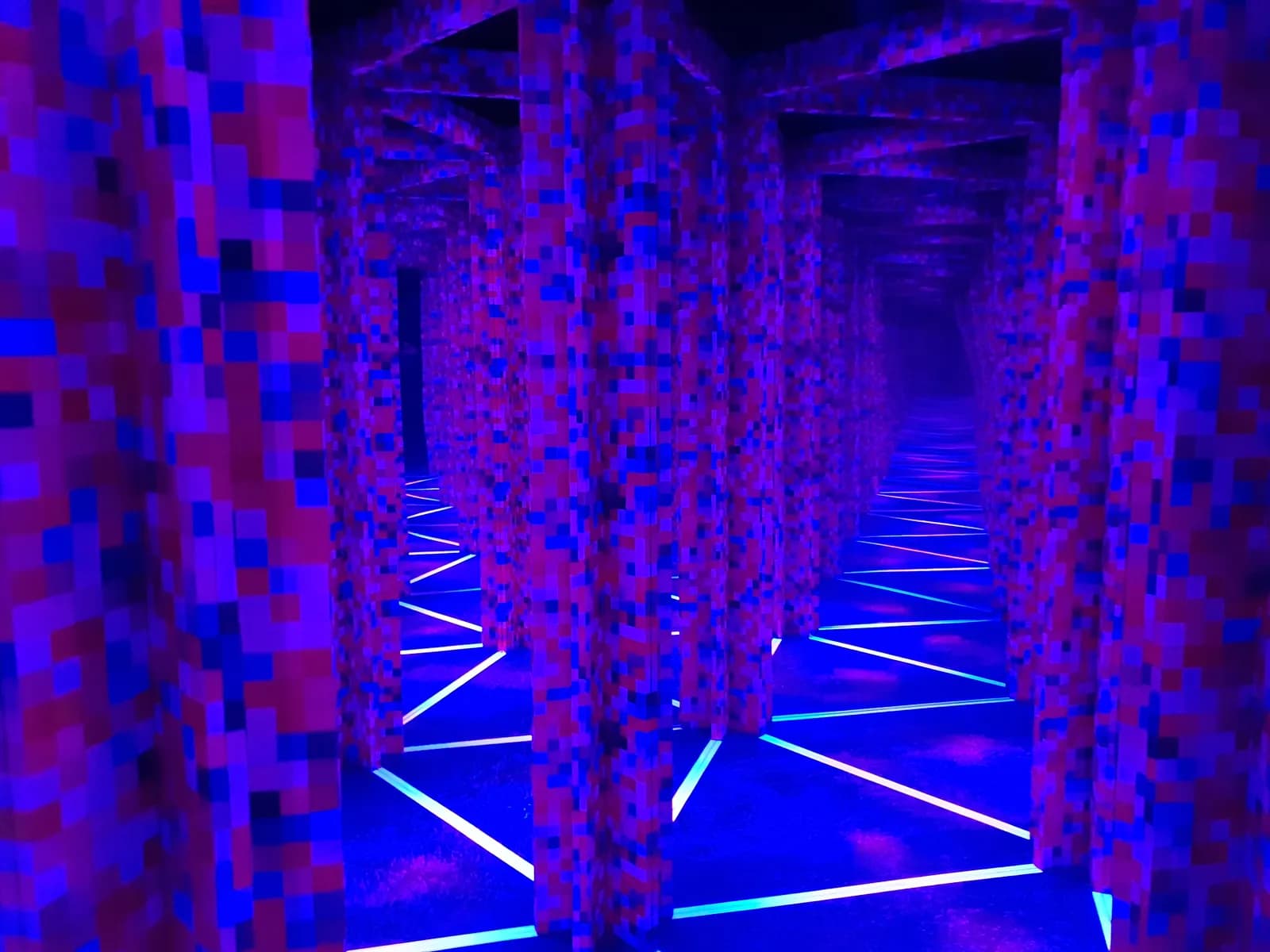
Mirrors are another recurring theme. The Mirror Rooms disrupt the expected relationship between a person and their reflection, while the Trickway uses mirrors to create a maze in which finding the exit becomes considerably more difficult than it first appears.
The collection also includes stereograms and impossible figures, introducing visitors to ways in which the brain interprets visual information. The Hollow Mask, for example, explores how the mind can misinterpret what it sees when an object does not behave according to familiar visual expectations.
There are also installations with a more playful character, including the Infinite Library, Diamondscope, Wow! Cube and the Cracked Room.
For younger visitors, the Castle includes a slide and mini climbing wall, alongside installations that explore colour, light, perspective and the experience of seeing the world from an unusual viewpoint.
From giant kaleidoscopes to a world without straight answers
Perhaps the most striking feature is the Planetscope, described as the largest kaleidoscope in Poland. Rather than looking through a small handheld device, visitors enter an environment where reflections and repeated patterns become the attraction.
The Infinity Room inside a giant Rubik's Cube takes a similar principle into three dimensions, while the Diamondscope places visitors inside an environment inspired by the geometry and reflections of a polished diamond.
There are also installations that deliberately break the rules of ordinary space. The Infinite Library creates the impression of an endless interior, while the 'But the Channel!' installation gives the sensation of floating above an apparently endless descent.
Even some of the more unexpected objects contribute to the same theme. The Trabant becomes the setting for a three-dimensional experience, while Rudy 102, inspired by the T-34 tank, introduces a more familiar physical object into the centre's world of visual tricks.
The result is an attraction that sits somewhere between an art gallery, science centre, photography set and family activity. It does not require visitors to understand the mathematics or psychology behind every illusion, but many of the installations naturally invite questions about why the eye and brain interpret an image in a particular way.
That is perhaps the most interesting aspect of Trickorama. The illusions may be playful, but they demonstrate something quite serious about perception: seeing is not simply a matter of receiving information through our eyes. Our brains are constantly interpreting, correcting and sometimes misreading what is in front of us.
In Radom, that idea has been turned into a physical experience. Instead of asking visitors to look more closely at an illusion from a safe distance, Trickorama invites them to step into it, move through it and become part of the image.
For a city better known for its industrial, architectural and historical heritage, it also offers a distinctly contemporary way to engage with art and science. Here, the most important object in the room is often the visitor themselves.
Visitor Information
Venue: Trickorama
ul. Młodzianowska 75, Radom
Opening Hours
Monday: 10:00–19:00
Tuesday: 10:00–19:00
Wednesday: 10:00–19:00
Thursday: 10:00–19:00
Friday: 10:00–19:00
Saturday: 10:00–19:00
Sunday: 10:00–19:00